• Home • Tax & Accounting Products • CPE • Customer Training • Tax & Accounting News • Support • Contact Us • About Us • Shop
LOCATE A SALES REP
SITE LOGIN/REGISTER CATALOG QUICK SHOP PRODUCT LOGIN
Practice Area: Taxation  Brand: PPC,Checkpoint

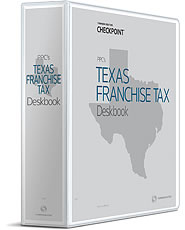
Texas Franchise Tax Deskbook  
Email this page  | Print Product Details  | Bookmark this page 

Everything you need to file Texas franchise (margin) tax returns and devise tax planning strategies throughout the year!

INTRODUCTORY MATERIAL
ABOUT THE AUTHORS . . .
APPLICABILITY OF TEXAS FRANCHISE TAX
Chapter 1: Applicability of Texas Franchise Tax
Introduction
KEY ISSUE 1A Taxpayers Subject to the Texas Franchise Tax.
Entities Subject to the Texas Franchise Tax
Nexus
Exemptions
Effective Date and Transitional Rules
Is It an Income Tax?
Constitutional Questions
KEY ISSUE 1B Taxable Entities.
Taxable Entities
Combined Group
KEY ISSUE 1C Passive Entities.
Must Satisfy Two Tests
Rent
Certain Nonoperator Income
Active Trade or Business Income
KEY ISSUE 1D Combined Groups.
Combined Group
Combined Reporting Requirement
Basic Approach to Combined Reporting
KEY ISSUE 1E Effective Date and Transitional Rules.
Effective Date
Transitional Rules for Existing Corporations and LLCs Previously Subject to the Franchise Tax
Transitional Rules for Taxpayers Not Previously Subject to the Franchise Tax
KEY ISSUE 1F Not an Income Tax.
KEY ISSUE 1G Constitutional Issues.
ILLUSTRATION 1-1 :
This component should be backspaced into the head:ill.Transitional Guidance Posted on the Comptroller's Website
Chapter 2: Margin Tax Formula
Introduction
KEY ISSUE 2A Margin Tax Formula.
KEY ISSUE 2B Elective EZ Margin Tax Formula.
KEY ISSUE 2C Total Revenue from the Entire Business.
Basic Inclusions
Basic Exclusions
KEY ISSUE 2D Deduction for Cost of Goods Sold, Compensation, or 30% of Total Revenue.
30% of Total Revenue
Cost of Goods Sold
Compensation
KEY ISSUE 2E Deduction for Active Duty Pay.
KEY ISSUE 2F Apportionment Factor.
KEY ISSUE 2G Allowable Deductions.
KEY ISSUE 2H Tax Rates.
General Tax Rates
EZ Tax Rate
Additional Tax Rate
KEY ISSUE 2I Tax Discounts.
KEY ISSUE 2J Credits.
Franchise Tax Credits
Temporary Credit
KEY ISSUE 2K Tiered Partnership Structures.
KEY ISSUE 2L Combined Reporting.
Combined Reporting Requirement
Basic Approach to Combined Reporting
KEY ISSUE 2M Net Tax Due.
Filing Requirements
Extensions
Franchise Tax Payments
De Minimis Rules
Chapter 3: Foreign Entities and Nexus
Introduction
KEY ISSUE 3A Taxation Depends on Whether Nexus Exists.
Taxable Nexus
Nexus Hierarchy
Nexus for Texas Franchise Tax
Business Activities that Establish Nexus
Texas Nexus Questionnaire
P.L. 86-272
Certificate of Authority
KEY ISSUE 3B Exemptions from the Franchise Tax.
KEY ISSUE 3C Termination of Nexus.
Chapter 4: Exemptions from the Texas Franchise Tax
Introduction
KEY ISSUE 4A Franchise Tax Exemptions.
Trade Show Exemption
KEY ISSUE 4B Applying for an Exemption.
Applying for the Exemption
Applying for a 90-Day Provisional Exemption
Taxability Prior to the Establishment of an Exemption
KEY ISSUE 4C If the Exemption Is Granted.
KEY ISSUE 4D If the Exemption Is Not Granted.
KEY ISSUE 4E Revocation of Exemption.
KEY ISSUE 4F Trade Show Exemption.
Qualifying for the Exemption
Notifying the Comptroller
Solicitation Exemption under P.L. 86-272
ILLUSTRATION 4-1 :
This component should be backspaced into the head:ill.Texas Franchise Tax Exemptions under Subchapter B
Chapter 5: Applicable Laws and Rules
Introduction
KEY ISSUE 5A Statutory Law.
KEY ISSUE 5B Comptroller's Rules.
PAYMENT AND FILING REQUIREMENTS
Chapter 6: Tax Rates
Introduction
KEY ISSUE 6A Tax Rates.
General Tax Rate
Tax Rate for Retailers and Wholesalers
Tax Rate under the Elective EZ Computation Method
Additional Tax Rate
Tax Rate Table
KEY ISSUE 6B Retail and Wholesale Trade.
Taxpayers Eligible for the Tax Rate for Retailers and Wholesalers
Wholesale Trade
Retail Trade
Primarily Engaged in Retail or Wholesale Trade
Combined Reporting
1987 Standard Industrial Classification Manual
KEY ISSUE 6C Tax Discounts for Small Businesses.
KEY ISSUE 6D De Minimis Rules.
Taxpayers Treated as Owing No Franchise Tax
Minimum Tax
ILLUSTRATION 6-1 :
This component should be backspaced into the head:ill.Texas Franchise Tax Rates, Tax Discounts, and De Minimis Rules
ILLUSTRATION 6-2 :
This component should be backspaced into the head:ill.SIC Division F: Wholesale Trade
ILLUSTRATION 6-3 :
This component should be backspaced into the head:ill.SIC Division G: Retail Trade
ILLUSTRATION 6-4 :
This component should be backspaced into the head:ill.1987 SIC Manual Major Group 58: Eating and Drinking Places
Chapter 7: Tax Payments and Deposits
Introduction
KEY ISSUE 7A Payment Due Dates.
Due Dates
Extensions
Late Payment Penalties and Interest
KEY ISSUE 7B Payment by Electronic Funds Transfer.
EFT Requirement
Comptroller Notifies the Taxpayer Subject to the EFT Requirement
Voluntary EFT Payments
Comptroller Publications and Phone Numbers
KEY ISSUE 7C Payment by Credit Card.
KEY ISSUE 7D Protest Payments.
KEY ISSUE 7E Tax Deposits.
Chapter 8: Filing Requirements and Due Dates
Introduction
KEY ISSUE 8A Annual Franchise Tax Report.
Filing Requirement and Due Date
Transitional Rules
Taxpayers Not Previously Subject to the Franchise Tax
KEY ISSUE 8B Initial Franchise Tax Report.
Filing Requirement and Due Date
Survivors of Certain Mergers
Combined Reporting
Transitional Rules
KEY ISSUE 8C Final Franchise Tax Report.
Filing Requirement and Due Date
Filing a Final Report to Obtain a Certificate of Account Status
Transitional Rules
KEY ISSUE 8D No Tax Due Information Report.
No Tax Due Information Report and Due Date
Corporations Eligible to File a No Tax Due Information Report
Temporary Credit
KEY ISSUE 8E Nontaxable Entity Information Report.
Notification Requirement
Passive Entities
Taxable Entities
Nontaxable Entities
KEY ISSUE 8F Weekends and Holidays.
KEY ISSUE 8G Date Mailed Is Determined by Postmark or Carrier Mark.
KEY ISSUE 8H Electronic Reporting.
Franchise Tax Reports
Obtaining an Extension Electronically
KEY ISSUE 8I Survivors and Nonsurvivors of Mergers.
Survivors of Mergers
Nonsurvivors of Mergers
Former Merger Credit Repealed
Chapter 9: Extensions
Introduction
KEY ISSUE 9A Regular Annual Report.
Availability of Extensions
Regular Annual Reports--Extension to November 15
First Annual Report--Extension to November 15
Corporations Required to Pay Tax by EFT--Extension to August 15, then November 15
Obtaining an Extension Electronically
Failure to Timely File an Extension
Penalties and Interest
KEY ISSUE 9B Initial Report.
Initial Report Extension--45 Days
Extension Forms
KEY ISSUE 9C Final Report.
Final Report Extension--45 Days
Extension Forms
KEY ISSUE 9D Public Information and Ownership Information Reports.
KEY ISSUE 9E Natural Disasters.
Chapter 10: Amended Reports
Introduction
KEY ISSUE 10A General Rules for Amended Reports.
KEY ISSUE 10B Amended Reports Are Required in Certain Situations.
Amended Report Following an IRS Audit or an Amended Federal Return
Amended Report Following an Administrative or Judicial Proceeding
Extension of Statute of Limitations
KEY ISSUE 10C Filing an Amended Report.
KEY ISSUE 10D Change of Address.
Chapter 11: Public Information and Ownership Information Reports
Introduction
KEY ISSUE 11A Who Must File.
Public Information Reports
Ownership Information Reports
Reports Are Required Even If No Tax Is Due
Entities Not Required to File
KEY ISSUE 11B Forms.
Public Information Report
Ownership Information Report
KEY ISSUE 11C Due Date.
Due Date and Filing Requirement
Failure to File
KEY ISSUE 11D Extension.
KEY ISSUE 11E Mailing.
KEY ISSUE 11F Signature.
KEY ISSUE 11G Confidentiality.
KEY ISSUE 11H Barcode Procedures.
Chapter 12: Annual Report of Independently Procured Insurance
Introduction
KEY ISSUE 12A Tax Imposed.
Overview
Tax on Independently Procured Insurance
Tax on Unauthorized Insurance
KEY ISSUE 12B Comptroller's Authority to Collect the Tax on Independently Procured Insurance.
Foreign (non-Texas) Taxpayers
Taxpayers Domiciled or Headquartered in Texas
KEY ISSUE 12C Tax Rate.
KEY ISSUE 12D Due Date.
KEY ISSUE 12E Report.
ILLUSTRATION 12-1 :
This component should be backspaced into the head:ill.Comptroller Pub. 98-376, "Tax on Independently Procured Insurance"
TAXABLE ENTITIES
Chapter 13: Taxable, Nontaxable, and Passive Entities
Introduction
KEY ISSUE 13A Limited Liability Protection and Texas' Ability to Tax.
Taxable Entities
Texas Constitutional Law Prohibits Taxing Natural Persons
KEY ISSUE 13B Taxable Entities.
Partnerships
Limited Liability Partnerships (LLPs)
Corporations
Banking Corporations
Savings & Loan Associations
Limited Liability Companies (LLCs)
Business Trusts
Professional Associations (PAs)
Business Associations
Joint Ventures
Joint Stock Companies
Holding Companies
Combined Entities
Other Legal Entities
KEY ISSUE 13C Nontaxable Entities.
Sole Proprietorships
General Partnerships Comprised of Only Natural Persons
Passive Entities
Entities Exempt from Taxation under Subchapter B
Estates
Grantor Trusts
Escrows
REITs
REMICs
Nonprofit Self-Insurance Trusts
Qualified Retirement Plan and Stock Bonus Trusts
VEBAs
Insurance Companies Paying Insurance Gross Premiums Tax
KEY ISSUE 13D Passive Entities.
Nontaxable Status
Qualifying Type of Entities
90% Passive Income Sources Test
10% Active Sources Income Test
Active Trade or Business
Reporting Requirements
Taxable Entity Owning a Passive Entity
KEY ISSUE 13E Combined Reporting.
KEY ISSUE 13F Transitional Rules.
Beginning Effective Date for Entities Becoming Subject to the Revised Franchise (Margin) Tax
Continuing Partnerships
Mergers Prior to July 1, 2007
KEY ISSUE 13G Tax Planning Ideas for Taxable and Nontaxable Entities.
Choice of Entity
Passive Entities
Taxable Entities Owning Passive Entities
ILLUSTRATION 13-1 :
This component should be backspaced into the head:ill.Checklist for Taxable Entities
ILLUSTRATION 13-2 :
This component should be backspaced into the head:ill.Checklist for Nontaxable and Exempt Entities
ILLUSTRATION 13-3 :
This component should be backspaced into the head:ill.Checklist for Passive Entities
REVENUE AND APPORTIONMENT
Chapter 14: Total Revenue from the Entire Business
Introduction
KEY ISSUE 14A Total Revenue, Gross Receipts, and Federal Gross Income.
Total Revenue
Margin Tax Structure
Gross Receipts and Apportionments
Federal Gross Income
Special Rules for Computing Revenue of Combined Groups and Tiered Entities
KEY ISSUE 14B Reporting Gross Revenue.
General Rule for Gross Revenue
Gross Revenue of an Entity Treated as a Corporation
Gross Revenue of an Entity Treated as an S Corporation
Gross Revenue of an Entity Treated as a Partnership
Gross Revenue of an Entity Treated as a Trust
Gross Revenue of an Entity Treated as a Single Member LLC
Gross Revenue of Other Taxable Entities
KEY ISSUE 14C Subtractions from Gross Revenue.
Bad Debts
Foreign Royalties and Dividends
Net Distributive Income from Partnerships or S Corporations
Revenue from Disregarded Entities
Form 1120, Schedule C Special Deductions
KEY ISSUE 14D Exclusions from Gross Receipts.
Exclusions
Income from Passive Entities
Flow-through Funds Mandated by Law or Fiduciary Duty
Flow-Through Funds Mandated by Contract
Dividends and Interest from Federal Obligations
Lending Institutions
Legal Services
Pharmacy Cooperatives
Staff Leasing Companies
Management Companies
Health Care Providers and Institutions
Facilities Used by the Federal Government
Oil and Gas Produced During Certain Dates
KEY ISSUE 14E Tiered Partnership and S Corporation Rules.
Multiple Upper Tier Entities
KEY ISSUE 14F Combined Reporting Entities.
Federal Consolidated Tax Returns
KEY ISSUE 14G Worksheets and Tables.
ILLUSTRATION 14-1 :
This component should be backspaced into the head:ill.Sample Form 1120, Schedule C, Dividends and Special Deductions (See Key Issue 14D)
Chapter 15: Gross Receipts and Apportionment
Introduction
KEY ISSUE 15A Gross Receipts.
Gross Receipts for Margin
Gross Receipts Tied to the Entity's Federal Tax Return
Business Periods
Apportionment Factor
KEY ISSUE 15B Apportionment Factor.
General Rule--Apportionment Based on Gross Receipts
Regulated Investment Companies
Employee Retirement Plans
KEY ISSUE 15C Total Gross Receipts from the Entire Business.
Total Gross Receipts
Basic Inclusions
Subtractions from Federal Gross Receipts
Exclusions from Federal Gross Receipts
Adjustments for Tiered Partnerships and S Corporations
Allocated Revenue Excluded under Rule 3.587(c)(9)
Adjustments for the Apportionment Factor
KEY ISSUE 15D Texas Gross Receipts.
Texas Gross Receipts
Generalizations
Location of Payor
Specific Guidance
Sales of Tangible Personal Property
Exchanges
Capital Assets and Investments
Services
Rentals
Intangibles
Dividends and Interest
Advertising Revenues
Debts
Loans
Insurance, Condemnation, and Litigation Awards
Telephone and Internet Access
Transportation and Shipping
Other Business
Natural Gas Production
Combined Groups
KEY ISSUE 15E Summary and Worksheets.
ILLUSTRATION 15-1 :
This component should be backspaced into the head:ill.Worksheet for Computing Revenue and Apportionment from Form 1120
ILLUSTRATION 15-2 :
This component should be backspaced into the head:ill.Worksheet for Computing Revenue and Apportionment from Form 1120S
ILLUSTRATION 15-3 :
This component should be backspaced into the head:ill.Worksheet for Computing Revenue and Apportionment from Form 1065
ILLUSTRATION 15-4 :
This component should be backspaced into the head:ill.Worksheet for Computing Revenue and Apportionment for Nonbusiness Trusts from Form 1041
ILLUSTRATION 15-5 :
This component should be backspaced into the head:ill.Worksheet for Computing Revenue and Apportionment for a Single Member LLC
ILLUSTRATION 15-6 :
This component should be backspaced into the head:ill.Gross Receipts Apportionment Tables
COST OF GOODS SOLD
Chapter 16: Cost of Goods Sold Deduction
Introduction
KEY ISSUE 16A Taxable Entities Eligible to Deduct Cost of Goods Sold.
KEY ISSUE 16B Goods Defined.
Tangible Personal Property
Computer Programs
Television, Radio, Books, Videos and Films
Real Property
Agricultural Goods
KEY ISSUE 16C Items That Are Not Goods.
Intangible Property
Services
Leased and Rented Goods
KEY ISSUE 16D Determining Ownership of Goods.
Benefits and Burdens of Ownership
Ownership of Real Property
Government Contractors
Combined Group Members
KEY ISSUE 16E Method for Calculating Costs of Goods Sold.
KEY ISSUE 16F Electing to Capitalize or Expense Costs of Goods Sold.
Eligibility for Election
Electing to Capitalize
Electing to Expense
Changing An Election
KEY ISSUE 16G Costs Eligible for the Cost of Goods Sold Deduction.
Costs Includible in the Cost of Goods Sold Deduction
Direct Costs
Indirect or Administrative Overhead Costs
Other or Additional Costs
Ineligible Costs
Federal and Franchise Tax Cost of Goods Sold Computations Are Not Identical
Categorizing Costs
KEY ISSUE 16H Direct Costs Eligible for the Cost of Goods Sold Deduction.
Deductible Direct Costs
Direct Labor
Direct Materials
Handling and Storage Costs
Depreciation, Depletion, and Amortization
Leasing and Rental Costs
Repairs and Maintenance
Research and Development
Geological and Geophysical Costs
Taxes
Electricity Acquisition Costs
KEY ISSUE 16I Partnership Contributions Eligible as Direct Costs.
KEY ISSUE 16J Indirect Costs Eligible for the Cost of Goods Sold Deduction.
Indirect or Administrative Overhead Costs
Security Services
Legal Services
Data Processing Services
Accounting Services
Personnel Operations
General Financial Planning
General Financial Management
KEY ISSUE 16K Limitation on Indirect Costs--the 4% Rule.
Indirect and Administrative Overhead Costs
4% Limitation
Application to Combined Groups
KEY ISSUE 16L Other Costs Eligible for the Cost of Goods Sold Deduction.
Deterioration, Obsolescence, and Spoilage
Certain Preproduction Costs
Certain Post-production Costs
Insurance
Utilities
Quality Control
Licensing and Franchising
KEY ISSUE 16M Eligible Costs for Specific Industries.
Lending Institutions
Leasing Companies
Restaurants
Construction Contractors
Films and Broadcasting
KEY ISSUE 16N Costs Ineligible for the Cost of Goods Sold Deduction.
Non-production Rentals and Leases
Selling and Distribution
Advertising
Idle Facilities
Rehandling
Bidding Costs
Interest
Partner Contributions Already Deducted
Income Taxes
Strike Expenses
Officers' Compensation
Undocumented Workers
Armed Forces Housing
KEY ISSUE 16O Consistency Requirements.
KEY ISSUE 16P Transactions between Related Parties.
KEY ISSUE 16Q Combined Reporting of Cost of Goods Sold.
KEY ISSUE 16R Active Duty Pay.
ILLUSTRATION 16-1 :
This component should be backspaced into the head:ill.Worksheet for Computing Cost of Goods Sold
COMPENSATION
Chapter 17: Compensation Deduction
Introduction
KEY ISSUE 17A The Compensation Deduction.
KEY ISSUE 17B Eligible Persons.
Eligible Persons
Ineligible Persons
KEY ISSUE 17C Calculating Compensation.
Wages and Cash Compensation
Benefits
KEY ISSUE 17D Wages and CASH Compensation.
W-2 Wages
Net Distributive Income
Net Distributive Income from Form 1065
Net Distributive Income from Form 1120S
Stock Awards and Stock Options
KEY ISSUE 17E Limit on Wages and CASH Compensation.
KEY ISSUE 17F Benefits.
Workers' Compensation
Health Care
Employee Health Savings Accounts
Retirement Benefits
KEY ISSUE 17G Limitations on Benefits.
Wages and Cash Compensation
Employee Discounts
Employer's Share of Payroll Taxes
Working Condition Fringe Benefits
Employee's Share of Contributions
KEY ISSUE 17H Nondeductible Expenses.
Excluded items
Undocumented Workers
Armed Forces Housing
Employer's Share of Payroll Taxes
KEY ISSUE 17I Additional Deduction for Military Compensation.
Availability of Deduction
Calculating Additional Military Compensation
Cost of Training
KEY ISSUE 17J Additional Deduction for Health Care Benefits.
Amount of Deduction--First 12 Months
Amount of Deduction--Second 12 Months
Employee's Contributions Not Included
KEY ISSUE 17K Management Companies.
Management Companies and Managed Entities
Special Treatment Accorded Management Companies
Special Treatment Accorded Managed Entities
KEY ISSUE 17L Staff Leasing Companies.
Staff Leasing Companies and Client Companies
Special Rules for Staff Leasing Company
Special Rules for Client Companies
KEY ISSUE 17M Temporary Employment Services.
KEY ISSUE 17N Taxable Entities Holding Partnership Interests.
KEY ISSUE 17O Combined Reporting of Compensation.
ILLUSTRATION 17-1 : Sample IRS Form W-2
ILLUSTRATION 17-2 : Sample IRS Schedule K-1 (Form 1065)
ILLUSTRATION 17-3 : Worksheet for Computing Compensation
ILLUSTRATION 17-4 : Worksheet for Computing the Additional Deduction for Military Personnel
ILLUSTRATION 17-5 : Worksheet for Computing the Additional Deduction for Health Care Benefits
COMBINED REPORTING AND SPECIAL STATUS ENTITIES
Chapter 18: Combined Reporting and Unitary Taxation
Introduction
KEY ISSUE 18A Combined Groups.
Combined Groups Are Taxable Entities
Combined Reporting versus Consolidated Reporting
Group Level Election of COGS or Compensation
Group Level De Minimis Rules
Group Level EZ Computation
KEY ISSUE 18B Affiliated Groups.
Common Ownership or Control
Controlling Interest
Termination of Affiliated Group Membership
KEY ISSUE 18C Unitary Businesses.
Definition of a Unitary Business
Horizontal Integration (Same Line of Business)
Vertical Integration (Steps in a Process)
Functional Integration (Strong Centralized Management)
Other Factors
Comptroller Presumptions
Inter-Company Pricing
Joint, Shared, or Common Activities
Holding Entities
KEY ISSUE 18D Included Entities.
Non-Nexus Entities
Disregarded Entities
KEY ISSUE 18E Excluded Entities.
Exempt Entities
Passive Entities
Insurance Companies
KEY ISSUE 18F Foreign Entities.
Waters Edge Test
Multistate Factoring Under the Multistate Tax Compact
Property Factor
Payroll Factor
No Property or Payroll
KEY ISSUE 18G Combined Reporting Requirements.
Mandatory Combined Reporting
Separate Public Information Reports
Accounting Period
KEY ISSUE 18H Combined Reporting of Revenues.
KEY ISSUE 18I Combined Reporting of Cost of Goods Sold.
Arm's Length Requirement for Affiliates
KEY ISSUE 18J Combined Reporting of Compensation.
KEY ISSUE 18K Alternative Methods of Combined Reporting.
KEY ISSUE 18L Combined Apportionment.
Non-Nexus Out-of-State Entities
Solicitation Exemption under P.L. 86-272
Anti-Abuse Provision
KEY ISSUE 18M Combined Credits.
KEY ISSUE 18N Combined Tax Rate.
KEY ISSUE 18O Reporting Entity.
Choice of Reporting Entity
Rights and Responsibilities
Notice
Joint and Several Liability
Election to Include Disregarded Entity in Combined Group
Change in Reporting Entity
KEY ISSUE 18P Combined Extension Requests.
KEY ISSUE 18Q Planning for Combined Reporting.
Avoiding Combination
Promoting Combination
ILLUSTRATION 18-1 : Combined Reporting Worksheet
Chapter 19: Special Status Entities
Introduction
KEY ISSUE 19A Banks and Financial Institutions.
Taxable Entities
Calculating Margin
Apportioning Margin
Correspondent Banks
KEY ISSUE 19B Lending Institutions.
Revenue Exclusion
Cost of Goods Sold Deduction
KEY ISSUE 19C Health Care Providers.
Health Care Providers
Health Care Institutions
Excludible Program Payments
Costs of Uncompensated Care
KEY ISSUE 19D Legal Service Providers.
Flow-Through Funds
Expense Reimbursements
Pro bono Deductions
KEY ISSUE 19E Flow-through Funds.
Law or Fiduciary Duty
Contractual Duty
Sales Commissions
Tax Basis of Securities
Real Estate Subcontracting Payments
Pharmacy Cooperative Rebates
No Revenue Exclusions for Flow-Through Payments from Affiliates
KEY ISSUE 19F Staff Leasing Companies.
Revenue Exclusions for Staff Leasing Company
Deductible Expenses for Staff Leasing Company
Nondeductible Expenses for Staff Leasing Company
Deductible Expenses for Client Company
Nondeductible Expenses for Client Company
KEY ISSUE 19G Management Companies.
Limited Liability Status
Reimbursement Structure
Revenue Exclusions for Management Company
Deductible Expenses for Management Company
Nondeductible Expenses for Management Company
Deductible Expenses for Managed Entity
Nondeductible Expenses for Managed Entity
DEDUCTIONS, CREDITS, AND REFUNDS
Chapter 20: Allowable Deductions
Introduction
KEY ISSUE 20A Allowable Deductions.
Allowable Deductions Authorized
Former Deductions Repealed
KEY ISSUE 20B Solar Energy Device.
Deduction Allowed for Solar Energy Devices
Amortization Schedule Must Be Filed with the Comptroller
Deduction Limitation and Carryover
Claiming the Deduction
KEY ISSUE 20C Equipment Used in a Clean Coal Project.
Deduction Allowed for Equipment Used in a Clean Coal Project
Amortization Schedule Must Be Filed with the Comptroller
Deduction Limitation and Carryover
Claiming the Deduction
KEY ISSUE 20D Claiming an Allowable Deduction.
EZ Computation Filers
Regular Tax Computation Filers
Chapter 21: Temporary Credit
Introduction
KEY ISSUE 21A Temporary Credit.
Temporary Credit Replaces the Old Business Loss
Eligibility for the Credit
Preserving the Right to Take the Credit
Claiming the Credit
Transitional Rules
KEY ISSUE 21B Temporary Credit Replaces the Former Business Loss Deduction.
KEY ISSUE 21C Eligibility for the Credit.
Eligibility
Combined Groups
KEY ISSUE 21D Preserving the Right to Take the Credit.
Notifying the Comptroller
Form 05-172
Changes in the Preserved Amount
KEY ISSUE 21E Electing to Take the Temporary Credit.
Election Requirement
Claiming the Credit
KEY ISSUE 21F Calculating the Temporary Credit.
Calculating the Temporary Credit
Worksheets for Calculating the Credit
KEY ISSUE 21G Revoking the Temporary Credit.
KEY ISSUE 21H Transitional Rules.
KEY ISSUE 21I Tax Planning Ideas for the Temporary Credit.
ILLUSTRATION 21-1 : Form 05-172 (Preservation of Temporary Credit)
ILLUSTRATION 21-2 : Worksheet for Computing the Temporary Credit
ILLUSTRATION 21-3 : Sample Filled-in Worksheet for Computing the Temporary Credit for a 2008 Report
ILLUSTRATION 21-4 : Sample Filled-in Worksheet for Computing the Temporary Credit for a 2009 Report
Chapter 22: Tax Credits
Introduction
KEY ISSUE 22A Tax Credits Available.
Overview
New Tax Credit for Enterprise Projects
Repeal of Tax Credits with No Carryover Provision
Repeal of Tax Credits with Carryover Provisions
Economic Development Credits
Merger Credit
Temporary Credit
KEY ISSUE 22B Credit for Enterprise Projects.
Overview
Credit for Capital Investment in a Texas Enterprise Zone
Eligibility
Limitations and Carryover
Claiming the Credit
Expiration of the Credit
KEY ISSUE 22C Credit for Research and Development.
Overview
Credit Only for Research in Texas
Alternative Computation Permitted
Multiplier for Research Conducted in a Texas Strategic Investment Area
Limitations under Pre-2008 Law
Credit Carryforward under Pre-2008 Law
Claiming the Credit under Pre-2008 Law
Transitional Rules for Post-2007 Reports
KEY ISSUE 22D Credit for Job Creation.
Overview
Credit for Job Creation in Texas
Eligible Corporations and LLCs
Limitations under Pre-2008 Law
Credit Carryforward under Pre-2008 Law
Claiming the Credit under Pre-2008 Law
Transitional Rules for Post-2007 Reports
KEY ISSUE 22E Credit for Capital Investment.
Overview
Credit for Capital Investment in Texas
Eligible Corporations
Limitations under Pre-2008 Law
Credit Carryforward under Pre-2008 Law
Claiming the Credit under Pre-2008 Law
Transitional Rules for Post-2007 Reports
KEY ISSUE 22F Economic Development Credits.
KEY ISSUE 22G Former Credit for Survivors of Mergers Repealed.
Chapter 23: Tax Refund Opportunities
Introduction
KEY ISSUE 23A Refunds Available.
KEY ISSUE 23B Refund for Job Creation in a Texas Enterprise Zone.
Refund for Job Creation
New Job Creation
Claiming the Refund
KEY ISSUE 23C Refund for Employing Persons Receiving State Financial or Medical Assistance.
Refund for Employing Persons Receiving AFDC Payments
Claiming the Refund
KEY ISSUE 23D Refund for Property Taxes Imposed by School Districts.
Refund for School Taxes
Eligible Property
Claiming the Refund
KEY ISSUE 23E Assignment of Right to a Tax Refund.
ILLUSTRATION 23-1 : Assignment of Right to Refund
ACCOUNTING METHODS AND PERIODS
Chapter 24: Accounting Methods
Introduction
KEY ISSUE 24A Federal Income Tax Method Required.
Total Revenue from the Entire Business
Gross Receipts
Cost of Goods Sold
Compensation
Frozen Internal Revenue Code
KEY ISSUE 24B Separate Books Are Not Permitted for Margin Tax Purposes.
Separate Books Are Not Permitted
Separate Schedules May Be Necessary for Inventory
KEY ISSUE 24C Double Entry Bookkeeping.
Double Entry Bookkeeping Repealed
Failure to Keep Required Books and Records
KEY ISSUE 24D Changes in Methods of Accounting.
KEY ISSUE 24E Combined Reporting Requirements.
KEY ISSUE 24F Financial Statement Presentation Issues.
Financial Accounting Treatment of the Texas Franchise Tax
FIN 48 Issues
Chapter 25: Privilege Periods and Business Periods
Introduction
KEY ISSUE 25A Privilege and Business Periods.
Privilege Period
Business Period
Special Rules for Initial Reports
Final Report
KEY ISSUE 25B Privilege Periods.
Initial Privilege Period
Second Privilege Period
Regular Annual Privilege Period
Privilege Periods Included on the Initial Report
Privilege Periods Included on an Annual Report
Final Report
KEY ISSUE 25C Business Periods.
Initial Reports
Regular Annual Report
Odd Results--Initial Reports Covering the Initial and Second Privilege Periods
Odd Results--Initial Reports Covering the First, Second, and First Regular Annual Privilege Periods
Final Report
Deferral Opportunity
KEY ISSUE 25D Planning Opportunities.
Basic "Permanent" Tax Deferral Opportunity
Planning Chart Showing Deferral Opportunity
Conclusion
KEY ISSUE 25E Survivors and Nonsurvivors of Mergers.
ILLUSTRATION 25-1 : Planning Chart Showing Permanent Tax Deferral Opportunity
Chapter 26: Financial Statement Presentation
Introduction
KEY ISSUE 26A Overview.
KEY ISSUE 26B Franchise Tax or Income Tax?
KEY ISSUE 26C Accounting for the Franchise Tax under SFAS No. 109.
Overview of SFAS No. 109
Calculating Current Income Taxes
Calculating Deferred Income Taxes
Financial Statement Presentation
Disclosing a Reconciliation of Income Taxes Attributable to Continuing Operations with Income Taxes Based on Statutory Rates
Other Disclosures
Summary
KEY ISSUE 26D Understanding the Impact of Fin 48.
FIN 48 in a Nutshell
State Issues Related to FIN 48
How FIN 48 Applies to Taxable Entities Subject to the Texas Franchise Tax
Tax Position as Defined under FIN 48
When a Tax Position Is Recognized
Tax Positions That No Longer Meet the More-likely-than-not Standard
State Tax Positions That Fall under FIN 48
Interest Accrual
Effect of FIN 48 on Financial Statements
What FIN 48 Means to Tax Practice
ILLUSTRATION 26-1 : Checklist for FIN 48
INITIAL AND FINAL REPORTS
Chapter 27: Initial Franchise Tax Report
Introduction
KEY ISSUE 27A Initial Franchise Tax Report.
KEY ISSUE 27B Events That Trigger an Initial Report.
Texas Taxable Entities
Foreign Taxable Entities
KEY ISSUE 27C Due Date of Initial Report.
Due Date
Transitional Rules
Report Forms
Extension
KEY ISSUE 27D Privilege Periods Covered by an Initial Report.
Privilege Periods
Minimum Period Covered by an Initial Report
Maximum Period Covered by an Initial Report
KEY ISSUE 27E Calculating Tax on Taxable Margin.
Tax Rate
Business Period
Transitioning to an Annual Reporting Period
Tax Savings and Deferral Opportunity
KEY ISSUE 27F Sample Initial Reports.
Initial Report Covering the Initial and Second Privilege Periods
Initial Report Including the First Regular Annual Privilege Period
ILLUSTRATION 27-1 : Sample Initial Report Covering the Initial and Second Privilege Periods
ILLUSTRATION 27-2 : Sample Initial Report when First Regular Annual Privilege Period Is Included
Chapter 28: Final Franchise Tax Report
Introduction
KEY ISSUE 28A Purpose of the Final Franchise Tax Report.
KEY ISSUE 28B Entities Required to File a Final Franchise Tax Report.
Requirement to File a Final Report
Subchapter B Exemptions
Public Information and Ownership Information Reports
KEY ISSUE 28C Certificate of Account Status.
KEY ISSUE 28D Final Report Form.
KEY ISSUE 28E Due Date of Final Report.
Due Date
Amended Final Report May Be Necessary
Midyear Final Report Does Not Eliminate the Need to File an Annual Report
Extension to File Final Report
KEY ISSUE 28F Additional Tax Rate.
Tax Rate
De Minimis Tax
Total Revenue of $300,000 or Less
No Refunds of Franchise Tax
KEY ISSUE 28G Final Business Period.
KEY ISSUE 28H Allowable Deductions.
Allowable Deductions
Business Loss Carryforwards
KEY ISSUE 28I Tax Credits.
Enterprise Project Credit
Carryover Credits
Economic Development Credits
Credit for Certain Banks
Temporary Credit
Limitations
KEY ISSUE 28J Transitional Rules.
Corporations and Limited Liability Companies
Partnerships, Joint Ventures, Professional Associations, Etc.
KEY ISSUE 28K Examples.
Final Business Period of Less than 12 Months
Final Business Period of More than 12 Months
ILLUSTRATION 28-1 : Sample Filled-in Final Report for a Final Business Period Under 12 Months
ILLUSTRATION 28-2 : Sample Filled-in Final Report for a Final Business Period Over 12 Months
ILLUSTRATION 28-3 : Quick Reference to Dissolve, Merge, or Convert a Texas Entity
ILLUSTRATION 28-4 : Quick Reference to Withdrawing or Terminating a Certificate of Authority
ILLUSTRATION 28-5 : Quick Reference to Reinstating a Corporate Charter, Certificate of Organization, or Certificate of Authority
PENALTIES, INTEREST, AND ADMINISTRATION
Chapter 29: Penalties and Interest
Introduction
KEY ISSUE 29A Penalties and Interest.
Monetary Penalties and Interest
Self-assessment No Longer Required
KEY ISSUE 29B Penalties.
5% Penalty for Failures Cured within 30 Days
Additional 5% Penalty If Failure Is Not Cured within 30 Days
Penalty Due when Extension Payments Are Inadequate
Penalty for Failure to Pay by EFT When Required
10% Penalty for Failure to Pay Tax after a Determination
10% Penalty for Failure to File an Amended Franchise Tax Return
50% Civil Fraud Penalty
KEY ISSUE 29C Interest on Delinquent Taxes.
Reports Originally Due after 1999
Reports Originally Due before 2000
Computing Interest
KEY ISSUE 29D Penalty and Interest Calculation on Extended Reports.
KEY ISSUE 29E Reasonable Diligence and Waiver of Penalties and Interest.
Waiver of Penalties and Interest Based on Reasonable Diligence
Waiver of Taxes, Penalties, and Interest
KEY ISSUE 29F Criminal Fraud Penalty.
KEY ISSUE 29G Forfeiture of Privileges.
KEY ISSUE 29H Interest on Tax Overpayments.
Chapter 30: Statute of Limitations
Introduction
KEY ISSUE 30A Statute of Limitations on Assessment.
KEY ISSUE 30B Statute of Limitations on Refunds.
KEY ISSUE 30C Interest on Tax Underpayments and Overpayments.
Interest on Tax Underpayments
Interest on Tax Overpayments
KEY ISSUE 30D Agreement to Extend the Statute of Limitations.
KEY ISSUE 30E Extension of Statute of Limitations Following IRS Audit Adjustments and Amended Returns.
Requirement to File Amended Report
Extension of Statute of Limitations
File Protective Claim for Refund when Contesting an IRS Audit Adjustment in Court
KEY ISSUE 30F Tolling of Statute of Limitations during an Administrative Hearing.
ILLUSTRATION 30-1 : Sample Agreement to Extend Period of Limitation
Chapter 31: Dealing Effectively with the Comptroller's Office
Introduction
KEY ISSUE 31A Contacts with the Comptroller's Office.
Audits and Appeals
Local Field Offices
Comptroller's Tax Practitioner Hotline
Written Requests for Rulings
Comptroller's Website--Window on State Government
Taxpayer Bill of Rights
Comptroller's Authority to Outsource Tax Audits or Permit Taxpayers to Hire Tax Auditors
KEY ISSUE 31B Audits.
Notice of Routine Audit
The Audit
Completion of an Agreed Audit
Completion of a Disagreed Audit
KEY ISSUE 31C Independent Audit Review--Administrative Appeal before an Audit Is Finalized.
KEY ISSUE 31D Redetermination--Administrative Appeal after an Audit.
Overview
The Redetermination Process
Case Transferred to the Administrative Hearings Section (AHS)
KEY ISSUE 31E State District Court.
KEY ISSUE 31F Comptroller's Settlement Authority.
ILLUSTRATION 31-1 : Texas Comptroller Field and Audit Offices
ILLUSTRATION 31-2 : Sample Request for Ruling
ILLUSTRATION 31-3 : Sample Limited Power of Attorney
ILLUSTRATION 31-4 : Sample Petition for Redetermination and Statement of Grounds
ILLUSTRATION 31-5 : Comptroller's Rules of Practice and Procedure Publication No. 96-145 (May 2007)
ILLUSTRATION 31-6 : Tax Division Frequently Asked Questions
ILLUSTRATION 31-7 : Frequently Asked Questions About Dispute Resolution at SOAH
ILLUSTRATION 31-8 : Guidelines for Mediated Settlement Conferences
ILLUSTRATION 31-9 : What You Need to Know for Your Mediated Settlement Conference at SOAH
ILLUSTRATION 31-10 : Tax Case Settlement Guidelines
PLANNING IDEAS
Chapter 32: Franchise Tax Planning Ideas
Introduction
KEY ISSUE 32A Planning Ideas for Taxable and Nontaxable Entities.
Choice of Entity
Passive Entities
Taxable Entities Owning Passive Entities
KEY ISSUE 32B Planning Ideas for Total Revenue.
Special Status Tax Payers
KEY ISSUE 32C Planning Ideas for Gross Receipts and Apportionment.
Gross Receipts Base Tax Perks
Apportionment
KEY ISSUE 32D Planning Ideas for Cost of Goods Sold.
Election to Capitalize versus Expense Currently
Categorizing Costs
KEY ISSUE 32E Planning Ideas for Compensation.
$300,000 Cap on Wage and Cash Compensation
Military Pay Deduction
KEY ISSUE 32F Planning Ideas for the Tax Rate.
Wholesalers and Retailers
EZ Tax Computation
KEY ISSUE 32G Planning Ideas for the Temporary Credit.
KEY ISSUE 32H Planning Ideas for Combined Reporting.
Avoiding Combination
Promoting Combination
Chapter 33: Electronic Tax Research
Introduction
KEY ISSUE 33A Tax Research Engagements.
KEY ISSUE 33B Locating and Evaluating Authorities Relevant to the Texas Franchise Tax.
KEY ISSUE 33C Texas Comptroller's "Window on State Government."
KEY ISSUE 33D State Tax Automated Research (STAR) System.
Overview
STAR Home Page
STAR Training Classes
Document Types
Document Status
Document Tax Type
Search Forms
Simple Search
Advanced Search
Subject Matter Index
Reverse Topical Index
ILLUSTRATION 33-1 : Texas Comptroller's Window on State Government Home Page (www.window.state.tx.us)
ILLUSTRATION 33-2 : State Tax Automated Research (STAR) System Home Page (http://cpastar2.cpa.state.tx.us/index.html)
ILLUSTRATION 33-3 : STAR System Query Results Screen
ILLUSTRATION 33-4 : STAR System Advanced Search Screen
ILLUSTRATION 33-5 : STAR System Subject Matter Index and Reverse Topical Index Search Screen
ILLUSTRATION 33-6 : STAR System Subject Matter Index Results Screen
ILLUSTRATION 33-7 : STAR System Subject Matter Index Accession Numbers
ILLUSTRATION 33-8 : STAR System Reverse Topical Index Results Screen
FRANCHISE TAX LAW
Chapter 34: Franchise Tax Law
Introduction
KEY ISSUE 34A Hierarchy of Authority.
KEY ISSUE 34B Organization of Texas Statutes.
KEY ISSUE 34C Texas Tax Code.
KEY ISSUE 34D History of Texas Franchise Tax.
KEY ISSUE 34E Copy of Franchise Tax Law.
ILLUSTRATION 34-1: Texas Franchise Tax Law
COMPTROLLER RULES
Chapter 35: Comptroller of Public Accounts Franchise Tax Rules
Introduction
KEY ISSUE 35A Rules in This Deskbook.
KEY ISSUE 35B Types of Rules.
KEY ISSUE 35C The Administrative Rulemaking Process.
Comptroller's Authority to Promulgate Administrative Rules
The Rulemaking Process
Regular Rulemaking
Emergency Rulemaking
KEY ISSUE 35D Location of Rules.
KEY ISSUE 35E Listing of Rules.
ILLUSTRATION 35-1: Texas Comptroller of Public Accounts Franchise Tax Rules
FORMS AND INSTRUCTIONS
FORM F101: Introduction to Forms Section
FORM F201: Initial/Annual Franchise Tax Report
FORM F202: EZ Computation Report
FORM F203: No Tax Due Information Report
FORM F301: Extension Request
FORM F302: Extension Affiliate List
FORM F401: Preservation of Temporary Credit
FORM F402: Credits Summary Schedule
FORM F403: Affiliate Schedule
FORM F404: Tiered Partnership Report
FORM F405: Staff Leasing Services Company Report
FORM F406: Payment Form
FORM F501: Public Information Report
FORM F502: Ownership Information Report
FORM F601: Annual Insurance Tax Report
FORM F602: Instructions to Annual Insurance Tax Report
FORM F701: Texas Nexus Questionnaire (for certain non-Texas entities)
FORM F702: Bank Nexus Questionnaire (for certain Texas entities and foreign country banks)
FORM F703: Texas Business Questionnaire
FORM F801: Request for Certificate of Account Status
FORM F802: Tax Clearance Letter Request for Reinstatement of Tax Forfeitures
FORM F901: Texas Franchise Tax Report Information and Instructions
WORKSHEETS
WORKSHEET W101: Worksheet for Computing Revenue and Apportionment from Form 1120
WORKSHEET W102: Worksheet for Computing Revenue and Apportionment from Form 1120S
WORKSHEET W103: Worksheet for Computing Revenue and Apportionment from Form 1065
WORKSHEET W104: Worksheet for Computing Revenue and Apportionment for Nonbusiness Trusts from Form 1041
WORKSHEET W105: Worksheet for Computing Revenue and Apportionment for a Single Member LLC
WORKSHEET W201: Worksheet for Computing Cost of Goods Sold
WORKSHEET W301: Worksheet for Computing Compensation
WORKSHEET W302: Worksheet for Computing the Additional Deduction for Military Personnel
WORKSHEET W303: Worksheet for Computing the Additional Deduction for Health Care Benefits
WORKSHEET W401: Worksheet for Computing the Temporary Credit
WORKSHEET W501: Combined Reporting Worksheet
CHECKLISTS
CHECKLIST C101: Checklist for Taxable Entities
CHECKLIST C102: Checklist for Non-Taxable and Exempt Entities
CHECKLIST C103: Checklist for Passive Entities
CHECKLIST C201: Checklist for FIN 48
TABLES
TABLE T101: Texas Franchise Tax Rates, Tax Discounts, and De Minimis Rules
TABLE T102: Texas Franchise Tax Report Due Dates and Extensions
TABLE T103: Texas Franchise Tax Exemptions under Subchapter B
TABLE T201: Texas Franchise Tax Allowable Deductions
TABLE T202: Texas Franchise Tax Refund Opportunist
TABLE T203: Texas Franchise Tax Credits
TABLE T301: Gross Receipts Apportionment Tables
RESOURCES
RESOURCE R101: Sample Engagement Letter for Texas Franchise Tax and Public Information Reports (Long Form)
RESOURCE R102: Sample Engagement Letter for Texas Franchise Tax and Public InformationReports (Short Form)
RESOURCE R103: Sample Transmittal Letter for Texas Franchise Tax and Public Information Reports
RESOURCE R104: Sample Filing Instructions for Texas Franchise Tax and Public Information Reports
RESOURCE R105: Sample "Thank You" Letter to Clients and Survey
RESOURCE R106: Record of Telephone Conversation/Meeting
RESOURCE R107: Client Tax Research Documentation
RESOURCE R108: Tax Information on the Internet
CPE & Training Solutions
INDEX
CPE related to these PPC Guides is now available!

New this year, visit Course Finder at trainingcpe.thomson.com to download course materials related to these PPC Guides in PDF format at no cost. For many of these courses, you can also opt to use our new Online Grading Center to submit your completed exams. Click on each title below to view available self-study courses related to these PPC Guides. Also new this year—course materials related to these PPC guides are now available in the CPE tab on Checkpoint!

PPC's 1040 Deskbook
PPC's Guide to GAAS
PPC's Guide to Write-Up Services
PPC's Guide to Single Audits
PPC's Guide to Preparing Governmental Financial Statements
PPC's Tax Planning Guide—Partnerships
PPC's Guide to Preparing Financial Statements
PPC's Guide to Tax Planning for High Income Individuals
PPC's Practitioners Tax Action Bulletin Newsletters
PPC's Guide to Real Estate
PPC's Guide to HUD Audits
PPC's Guide to Homeowners' Associations
PPC's Guide to Cash, Tax, and Other Bases of Accounting
PPC's Guide to GAAP
PPC's Guide to Auditor's Reports
PPC's Guide to Audits of Local Governments
PPC's Guide to Business Valuations
PPC's Tax Planning Guide - S Corporations
PPC's Guide to Construction Contractors
PPC's Small Business Tax Guide
PPC's Guide to Audits of Financial Institutions
PPC's Guide to Compilation and Review Engagements
PPC's Guide to Small Employer Retirement Plans
PPC's Guide to Audits of Employee Benefit Plans
PPC's Guide to Audits of Nonpublic Companies
PPC's 990 Deskbook
PPC's Guide to Quality Control
PPC's Guide to Audits of Nonprofit Organizations
PPC's QuickBooks Solutions
Now it's easier than ever to meet your CPE requirements with the PPC guidance you use and trust!

The CPE & Training Solutions Online Grading Center gives you easy access to many print-based self-study courses and allows you to complete your CPE exams online for immediate results. Plus, the My Courses feature provides convenient retention and retrieval of your CPE course certificates and completions. Features include:

Immediate 24/7 Grading: Grading is now available 24-hours per day, seven days per week. Submit your final exam for grading at any time, and you’ll get immediate results and certification.

No Express Grading Fee: There’s no additional charge for completing the exam online. You will only be charged the normal course grading fee.

Convenient Retention and Retrieval of CPE Course Completions: CPE Certifications are available for every print course exam you successfully complete in the Online Grading Center.
PPC offers print-based self-study in these topics:

You may access PPC Guide-related course materials at no charge by visiting Course Finder at trainingcpe.thomson.com and searching for PPC Self-Study Print-based courses. Many courses are available for PDF download directly from the Course Finder!

Accounting and Auditing
Consulting
Information Technology
Management
Personal Development
Specialized Industries
Taxation
Yellow Book

Over 50 courses available!


Home  |   FAQ  |   About Us   |   FeedBack/Contact Us   |   Site Map   |   Terms of Use   |   Privacy Statement   |   Tax Industry Websites
For Sales please call 1-800-950-1216 or locate your local representative.
©2010 Thomson Reuters. All rights reserved.

[B-A01]
[clientip=]
[Entry written to logfile.]